Lorem ipsum
Lorem ipsum
As AI systems become more ubiquitous, policymakers, technology companies, publishers, educators and students are called to play essential roles in how these tools are developed and used. In this piece, Dr Helen Beetham explores the risks AI poses to learning, expertise, creativity and educational integrity, challenging current assumptions about AI in education and arguing for the protection of what we understand learning to be.
An interview with Dr Helen Beetham, lecturer, researcher and consultant in digital education, on criticality and AI, conducted by Carles Vidal, MSc in Digital Education, Business Director of Avallain Lab
The following interview was initially planned to discuss the topic of critical thinking and GenAI in education, drawing on the report Avallain published last June, ‘From the Ground Up’. That text proposes 12 controls for safer, more ethical use of AI in education, and the idea of embedding critical thinking in both the design of these tools and in teaching practices is one of its core guidelines.
To explore these ideas further, we spoke with Dr Helen Beetham, a leading educational researcher and consultant whose current focus is set on criticality and AI. Right from the start, our conversation went beyond critical thinking as a product design strategy and a necessary learning skill to encompass a broader perspective on criticality.
In the following lines, Helen unpacks her views on AI and the risks its adoption implies for societies and educational systems in general, and for educators and students in particular. She points out the problematic nature of foundational models and the agendas driving them, and suggests a range of alternative policies and practices that should be considered to manage these risks.
For those looking for a silver lining, as Helen says, this moment is a great opportunity to think about tech and what we want from it. This is why this conversation is so timely, as only by understanding the complexities at stake will we be able to address them and ensure we continue to deliver real value from our technologies for publishers and educators.
Helen, given your area of research, we would like to address the importance of criticality and critical thinking in relation to GenAI tools, particularly the main risks the educational community faces, how to address them and the opportunities you see in these technologies.
First, I’m glad you identify that there are different actors with different powers to act.
Teachers, students, school and university leaders, AI developers and the foundation companies all have different responsibilities, and I wouldn’t expect the same kinds of criticality to apply. For teachers and learners, there are reasons to be critical that concern the learning process, and there are reasons to be critical that concern the systems we depend on to deliver education.
At the level of learning, paper after research paper has shown that people who use generative AI for significant tasks – reading, writing, coding, design – are not learning to do those tasks, or not in the ways they have previously been done. Retention is poor. Subsequent performance, for example, under exam conditions, is poor. Even expert skills are degraded through persistent use of AI. This is not at all surprising. We know that learning to read and write rewires the brain, and literacy is not a one-and-done skill; it’s something we continue to develop, or that can atrophy if we stop developing it. Arguably, the whole purpose of school is to develop people who can participate in the literate practices that societies value, and university is about developing more specialist literacies such as scientific, legal, technical and so on. When generative AI is used for those tasks, the relevant development of the brain, the understanding, the practice and even the identity is not going to happen. Something else might develop, such as a facility with the AI interface. So we need to look critically at that trade-off.
Another reason to be critical is the nature of the models these technologies rely on. Most accounts of ‘critical’ AI use focus on the outputs, especially the inaccuracies, biases and errors. You can improve those issues with post-training data labour, but fundamentally, the data model is not a world model, not even a reliable model of its training data. The errors are not going to go away. So ‘checking the outputs’ seems like an important critical response. But what does that mean? It can only mean checking against other information systems. And what happens when those other information systems are saturated with AI-generated content? The information/media literacy revolution encourages critical questions, but they mainly concern people and their motives: who authored this, when, and why, who is disseminating it, what interests are being served, with what designs on your opinions and behaviour and personal data? None of these questions can be asked of AI outputs, or really of any information in systems that are AI saturated. ‘Checking the outputs’ of AI requires us to completely reassess what is in circulation as information: what are its sources, authorities, meaning-making processes, and what systems have been involved? It’s not a simple matter of technique.
More concerning to me than the errors in outputs are the effects of stylistic and semantic flattening. Inference tends towards the middle. Everyone starts to sound and read the same. There are a few people, experts and creatives in their field, who are using generativity to push the boundaries of their own practice and good luck to them. But they have not developed in that practice by using generative AI. For learners who do not even know the range of responses that are possible, let alone how to evaluate the outlying and the innovative, the use of AI will always tend to the most standard response. In minority cultural and intellectual fields, the stereotyping effects are even more pronounced. It’s incredibly boring and demotivating, for teachers and students alike, to have rich learning materials reduced to five bullet points and for those bullet points to be expanded again to five paragraphs of entirely predictable student text. We keep asking: what do you think? What in all this material speaks to you? What do you care about? The whole point of education is to help people find the answers to these questions for themselves. I find learners increasingly reluctant to do that, because now there is always a safe answer. Of course, data models can describe different perspectives, provided these are already described in the training corpus. What they can’t do is help learners to develop their own perspective. So a critical stance might be one that asks how this kind of development, if we value it, can still take place.
A final reason to be critical is the gap between what the AI industry promised for education and what we have actually got. I studied AI in the 1980s, and I’ve worked in education technology, broadly speaking, since the 1990s, so I’ve been around a few hype cycles, but nothing quite like this one. People in education are not enamoured of AI, of the quality of its outputs. They are increasingly concerned about its downsides, especially for learners’ development. But the idea that if you don’t love AI, then you are the problem, the idea that if you don’t inject AI into every aspect of their experience, you are failing students, these ideas are pervasive. The GenAI challenge becomes a crisis if educators collude in the magical thinking and the myth-making. When we trust our disciplinary methods to help us understand GenAI, we can be critical in a whole variety of ways. And when GenAI refuses to be understood, because it entails blackbox architectures and deliberately obscure commercial practices, this is not a mystery to bow down before but a huge risk to truth-telling and responsible thought.
If you mean ‘can generative AI be used for positive educational ends?’, then of course, in the hands of a dedicated educator, any material can have learning value. I’ve been in classes where generative AI benchmarks are critiqued, where students research model biases and carbon footprints, and where they do journalistic work on AI companies. I’ve had students query system prompts, learn basic ML algorithms, and try a variety of creative responses to generated outputs. Educators are constantly experimenting and constantly learning. My experience is that the wider the variety of perspectives students have for understanding generative AI, the better chance they have of making a critical response. And it’s possible to support many different perspectives in the classroom.
If you mean ‘can students’ use of generative AI in their own independent study time be good for their learning?’, then I am more sceptical. I could break down the evidence for you, but what I would observe from my own experience is that the most engaged students, the ones that tend to be most thoughtful with generative AI in their learning process, are also the ones that are most concerned about losing skills and critical perspective. They are the students we should be engaging to help us build AI-resilient assessments and learning spaces. But just because some students are navigating generative AI thoughtfully, we can’t fulfil our responsibility to the rest by showing them good examples or preaching about ‘integrity’. Like fast food, ‘fast thought’ is irresistible: it offers compulsive and addictive behaviours in place of nourishment. According to The Brookings Institution, the costs of those behaviours for individual learners are already ‘daunting’.
And lastly, if you mean, ‘can data-based methods produce efficiencies in education systems?’ I’m sure those can be found. But the question of what we are accelerating and why is particularly pressing in education. We don’t ask students to produce assignments because we want more content in the world, but because we want students to learn. Ideally, we don’t ask academics to publish because we want more content in the world either, but because we want more meaningful research. Unfortunately, though, our systems have been set up to reward those proxies for thinking and for research, and GenAI enters those reward systems with what is, again, an irresistible promise to produce those proxies faster and get faster to the rewards.
People are becoming very aware of the costs. The GenAI moment is an opportunity to think critically about technology and what we want from it. I see big shifts in attitudes to social media, for example, and I think that’s an example of transformational change being driven by reactions to AI. But none of these shifts happens through interactions with GenAI alone, and there is now evidence that the more time people spend with chatbots and avatars, the less critical they are inclined to be.
None of the agents I have seen in use or in development has been very impressive at adapting to learners’ contexts and needs. I imagine that retraining has to go beyond extended prompting or RAG injection to get past the sycophancy and information-giving biases that are baked into the foundation models. More fundamentally, learners do not know what they do not know, or why it might be important, so learner-to-chatbot interactions on their own are very unlikely to initiate deep learning. The other approach is to involve teachers in defining the interactions they want learners to have. If teachers can define, in clear enough terms, the learning goals and needs of their class and if they can check, refine and contextualise what comes out of an AI application, I suggest they can probably adapt content and activities in more conventional ways. Many of the teacher-centred applications I’ve seen amount to good practice in lesson planning. But teachers still have to deliver on their plans. Say an AI-designed activity isn’t going as expected in class, do you fire up the AI and have another go? Teachers need to understand their materials if they are going to teach adaptively. So do we hand everything over – lesson plans, curricula, assessment rubrics, teaching materials, student feedback, and all the agency and skills and adaptability that go with really owning those things – do we hand that over to AI companies in return for fractional gains in lesson planning?
On your question about rich content, an activity I’ve shared with students for three years now is to generate images for educational use, based on a prompt from the OpenAI teaching materials. The results are always terrible, especially when compared with the resources you can find with an OER or Wikimedia search. This year, some students pushed back against the generative part of the activity on sustainability grounds. That has been an interesting development. But the positive part of the activity is that it makes students develop pedagogic judgement. The difference between the AI images and those chosen or designed by educators is a space for real learning. I’ve also had the experience of students and colleagues uploading my own materials, and generating podcasts, quizzes and gamified versions, and in one case, an app. The results were unrecognisable to me, so much design thinking and conceptual nuance were lost. But that’s not really the point. Every learner who wants one by now has an AI bot they can use to version content for themselves, whether they want it simplified, gamified, mind-mapped, transposed or translated, or given an anime makeover. There are accessibility gains here that I don’t want to trivialise. But I’m not sure where it leaves learning design. A bad outcome would be for education to disinvest in universal design and accessibility support because ‘learners are doing it with AI’. A worse outcome – just taking this to its logical conclusion – would be for learning design itself to disappear as a profession and as a shared language. If every learner is their own unique microcosm of intellectual needs and sensory preferences, if those needs can be met by ‘designs’ or ‘experiences’ generated on demand from the soup of educational content, what really is the role of the designer? Or the teacher, for that matter?
Behind the apparently empirical question ‘can GenAI applications provide effective learning support?’ are questions that might be a bit more uncomfortable. Such as: should GenAI interactions replace teaching interactions? Should teaching assistants and student support professionals become chatbots, or rather become the data workers who make the chatbots work? Perhaps most insidiously of all, should GenAI replace other students in the learning process? Alexandr Wang, head of Meta’s super-intelligence lab, has said he will wait to have kids until they can connect straight into the network mind and bypass all the messy interactions of school. Learners will kick back against further loss of contact with teachers, I suspect, but they are already voting with their feet for chatbot companions over peer learners. And that is really troubling. Social constructivist theory tells us it’s better to learn alongside other learners who are at a similar learning stage to us, who make similar mistakes and discoveries, who can be resources for our learning in their differences from us, despite the frictions and frustrations involved (that also teach us something). Yet we seem to be encouraging learners in the delusion that the perfect other is always available, and it is a chatbot.
I’m not sure expert use is necessarily effective and safe. There have been several longitudinal studies now, from MIT, Bloomberg and Stanford, that have found experts are not as productive with AI as they think they are. They are certainly not as productive as their bosses think they should be. It turns out ‘checking for inaccuracies’ and ameliorating losses of quality and context are non-trivial. Experts are slower than novices when they apply AI because they are aware of these issues and have to make judgments about them. What parts of a task might lend themselves to AI efficiencies? How best to realise them? What are the likely impacts on quality, safety and professional values? Experts are finding uses, but only with significant trade-offs, some of which may be visible only at the organisational or sector level.
From an educational point of view, yes, the worry is that novices never get to develop the judgment and expertise that is needed to work effectively with AI. Herbert Dreyfus’ original critique of the AI project, back in the 1960s and 1970s, was that it misunderstood the nature of expertise. Educators understand it better, for example, that it develops through iterative practice. That’s the point of learning spaces where novices can practice without high costs of failure, where they can get expert feedback, and develop fluency and judgement. All of those developmental processes are lost when learners use generative AI to produce what looks like expertise. At least, it looks like expertise to students, and this is another aspect of the paradox. It looks less like expertise to assessors. But we are working in a system that has previously taken that kind of evidence at face value, and where the time educators have to engage with students’ development has been pared away.
What the expertise paradox allows me to say to students is: I will not fail you for using AI. But AI can fail you, and you need to understand how that can happen.
The only remedy for students who avoid practice and engagement is to practice and engage, and to have support in place to do so. Perhaps some aspects of critical thinking might be supported with GenAI tools; I don’t rule it out, particularly when it comes to the critique of AI. But criticality and scepticism are not simple ‘techniques’. I know there has been a movement in media literacy, for example, to ‘inoculate’ young people against deepfakes, which sounds like a nice, simple shot in the arm. But what this inoculation involves is really a series of engagements. Typically, learners will spend time practising and applying diagnostic methods. Then they will create their own media pieces or ‘memes’. And finally, they will strategise to spread their memes, to make them as persuasive and pervasive as possible. Basically, they learn to make clickbait so they can learn not to be so easily baited. There are analogous activities you can do with GenAI, some of which engage learners more deeply with the data structure than others. The ‘inoculation’ task might be to prompt for a particular persona and interaction style, for example, and reflect on the results. It might be vibe coding a simple app and exploring the quality of the code. I think these are productive approaches, but they are not at all simple to implement.
A common remedy proposed for these problems is to teach students ‘good’ prompting strategies. When this involves using a particular template or standard, it seems to me counterproductive. It’s unlikely learners will surface anything interesting or discover the limitations of inference for themselves if prompting is reduced to a fill-the-gaps or cut-and-paste exercise. In fact, a lot of prompt crafting now takes place in the application layer, where interfaces may be even more frictionless than the familiar prompt screen. Larry Page looked forward to an AI search tool that would ‘understand exactly what you wanted before you knew yourself. For the foundation companies, the best prompt is one that entirely pre-empts the user’s needs. One of the critical exercises I do with students is to have them review chat logs and ask whether they think the user is prompting the chatbot, or the chatbot is prompting the user. But chatbot logs these days are often hidden in the application layer.
The alternative you suggest is that inference is made more effortful, for example, by defining the chatbot persona as a reflective mentor or a Socratic partner. I think this identifies the problem correctly, and it’s one I’ve discussed a lot with colleagues. How to ‘interrupt’ the straight line to the solution and introduce a more developmental path. What I’m not sure about is the possibility of installing these solutions as dialogic techniques within a chatbot interface. As I said in a previous answer, I have not yet found an AI agent that is effective in this mode. Either the moves are generic and stereotyped, or they come from examples in the training data. If there is a generic rule for ‘scepticism’, it can be reproduced in a list of reflective questions. And for a topic-based approach to ‘challenging a student’s logic’, generative AI should not, in my view, be the first resort either. Students learn more from co-teaching other students than they learn from interacting with a chatbot, because they are also doing the thinking involved in following the other person’s logic, noticing assumptions and blind spots, and recognising there are different perspectives on the same problem. Playing both sides is far more developmental.
The other issue is that learners turn to GenAI for complex reasons. Anxiety is often a big part of it, or the fear of missing out, or a lack of academic confidence. Dealing with these issues requires a deep engagement with learners. Learners need to understand why we ask them to do things (that they might do with GenAI), and we need to explain that better, but they also need good reasons for responding to those tasks in ways that feel challenging and uncertain. By the time learners reach the end of an undergraduate degree in the UK, they might have spent 18 years in an education system that values and measures outcomes. Valuing things that get in the way of the outcome is going to take more than individual encouragement or exhortation. It will require profound change.
Finally, much of the investment in GenAI has gone into interface effects that tend to undermine critical thinking. You can now talk to, vibe with and even engage with data models through wearables and emotion sensors. The effect is to undermine skills of mediation, or what used to be called literacy: conscious and effortful practices of engaging with other people’s thinking, and developing our own. The feeling of effortlessness and immediacy is not just about saving time. It is emotionally beguiling. You need never misunderstand or be misunderstood again.
Cognitive offloading is natural to human beings – it is one definition of culture – but it is never entirely safe. It creates vulnerabilities and dependencies. For example, we depend on shared signifying systems and tools, cultural records, and whoever controls them. I agree with Musk on this at least, that ‘safeguards’ are always ideological. It’s just that data models are inherently ideological, from their training data through the judgements of data workers to the contents of prompts. There is no way of steering AI models that is neutral. But unlike the cultural forms we have lived with for tens and hundreds of years, how they are ideological is obscure, and how they influence us is unfamiliar. There may come a time when we have no choice but to use GenAI if we want to participate in cultural and intellectual experiences, at least if we want to participate digitally. At that point, it might make sense to align oneself with particular architectures and not with others: Grok culture or Claude culture. But until then, and in hope it never comes, the ‘safe’ option I suggest is to keep practising alternative skills, interacting with other archives besides the data archive, maintaining and valuing other media, and nurturing our own embodied memories. Then, at least, there are alternative vantage points on the obscure ideologies and behavioural effects of the data model.
We already have tools and features of tools that support a focus on the learning process. Annotation is one that can be used both for solo reflection and for shared feedback. Document sharing, design spaces and coding environments, e-portfolios, all these are useful too. But you can build a process-oriented learning environment in just about any platform, or from simple open-source tools. What matters is the pedagogic intention. If we want education to be centred on processes of reasoning, and personal development, and on the specialist practices of each subject, we have to invest attention in these things and not in proxies for them, such as grammatical sentences or test scores. As soon as we standardise what we are looking for, that standard can become a data source or a prompt for GenAI. But moving away from standardised assessments and standard proxies for learning will require the kind of transformation I mentioned at the start. It would mean learners working on authentic challenges that arise from a real context – a context that provides its own standard, its own intrinsic feedback on students’ solutions. That might be the school or university and its community, or a placement setting, or a project with stakeholders. More learning would have to happen in shared, live, embodied spaces, and that learning would have to be high-quality if learners are to invest in it rather than in the electronic angel on their shoulder. Educators would have to enable and assess students’ work on its own terms, letting go of many proxies we have relied on before. This would have implications for teaching time and attention, and the places that learning happens, and therefore its costs.
A very small part of that is about the tools that are used. There may be some technical solutions for how learning relationships are mediated and how learning environments are made. I would stick my neck out and say we have all the functionality we need; we just need it to be more modular, more open, cheaper, and more flexible. But there really is no way to automate attention, witnessing, engagement, and care. This is what students need, and when they say they want a chatbot, what I hear is that they aren’t getting enough attention and care from other sources. We have to be very careful about contradicting students’ experiences, since that is a large part of what we are working with, but I do think we can challenge what they say they want from AI. That will involve confronting their fears. They are afraid of using AI. They are afraid of not using AI. Asking students to raise their eyes from these anxieties and think about what kind of learning and working futures they want is always an intense experience, but it is powerful. These deep engagements are what we need, in my view.
It is an irony that the use of generative AI by students has produced a workload crisis for teachers, at least those who are committed to student learning. It is exceptionally hard to read through an AI-generated or partially generated assignment to discern the work students have done, the process they have undertaken, and thus what guidance they need. If you don’t care, of course, it’s a breeze. Set your AI agent onto marking theirs. But if you do care, you know that the solution is to make the process itself the focus. We need teachers and students to build those processes together, and the learning environments that can support them. That would be a lot more exciting to me than asking what workflows GenAI can come up with or what new AI-integrated mega-platforms we need.
I did my fair share of foreseeing early on, and much of what I was saying now seems like common sense. So GenAI hasn’t kept improving with scale, productivity increases have been hard to demonstrate, and the promised educational benefits continue to be elusive.
I’m not an expert on the interface between the AI industry and edtech, in terms of the business models and the distribution of income. It seems to me that a lot of what passes for AI in education is rather shallow customisation in the application layer. At the moment, the foundation companies are very keen to secure subscriptions and use cases from education organisations, and of course, educational content and data. Bespoke educational applications may be a good way to forge those relationships, for now. But the long-term vision for these companies is not AI-enabled education; it’s AI instead of education. It’s something much more like the Neuralink, or Josh Dahn’s Synthesis, or Marc Andreessen’s vision of every child having their own dedicated AI tutor from birth, bypassing the need to engage with a shared learning culture. And while I personally think that is a fantasy, a dystopia, I do think the foundation companies will want to monetise everything they have learned from education and edtech in the medium term. To mine education, if you like, in order to undermine education.
As I said at the start, different actors in the educational space have different powers to choose from. I would love to see university leaders taking a more critical and ethically grounded position on generative AI. I’d like to see ministries and departments of education employing people who think deeply about these issues, rather than AI company secondments or industry-adjacent think tanks. I think that would make a considerable difference to how GenAI is implemented, or not implemented, in educational contexts.
I share the anxieties educators feel around generative AI, which makes us grasp at terms like ‘implementation’ so we can feel more in control. Generative AI is not being implemented. It was, as its proponents like to say, ‘unleashed’ on users and knowledge systems and cultural archives, every bit as irresponsibly as that sounds. Its developers have quickly become the richest companies in the world, dictating terms to governments, regulators and publishers. Every choice we make about AI in education is made downstream of these events, and in the face of this power. But choices are still possible. The most important, for me, is to tell the truth about GenAI, without hype or magical thinking, trusting our pedagogic and disciplinary methods to support us in that. And when those methods don’t help, to be truthful about our uncertainty.
We should be ready to challenge developments that extend the black box of not knowing and not being accountable further into our classroom practices. That means, I think, that we should insist on alternative knowledge archives and knowledge practices being available – that do not pass through generative data architectures – to protect what we understand student learning to be. Doing this demands technical ingenuity as well as intellectual commitment, and both are valuable skills in any foreseeable future. Just as we provide alternatives to social media in school and university platforms, where different rules and norms apply, I think we can do the same in relation to GenAI.

Dr Helen Beetham is an experienced consultant, researcher and educator working in the field of digital education in the university sector. Her publications include ‘Rethinking Pedagogy for a Digital Age’ (Routledge, 2006, 2010 and 2019), ‘Rethinking Learning for a Digital Age’ and an edited special issue of ‘Learning, Media and Technology’ (2022). Her current research centres on critical pedagogies of technology and subject specialist pedagogies, in the context of new challenges to critical thinking and humanist epistemology.
For two decades, Helen has advised global universities and international bodies on their digital education strategies, producing influential horizon scanning and research reports for Jisc. Her Digital Capabilities framework is a standard across UK Higher and Health Education, and she contributed to the European Union’s DigCompEdu framework, which incorporates AI and data competencies. An experienced educator, she has developed and taught master’s courses in education and learning design, and currently documents her research via her Substack, Imperfect Offerings.
For more than two decades, Avallain has enabled publishers, institutions and educators to create and deliver world-class digital education products and programmes. Our award-winning solutions include Avallain Author, an AI-powered authoring tool, Avallain Magnet, a peerless LMS with integrated AI, and TeacherMatic, a ready-to-use AI toolkit created for and refined by educators.
Our technology meets the highest standards with accessibility and human-centred design at its core. Through Avallain Intelligence, our framework for the responsible use of AI in education, we empower our clients to unlock AI’s full potential, applied ethically and safely. Avallain is ISO/IEC 27001:2022 and SOC 2 Type 2 certified and a participant in the United Nations Global Compact.
_
Contact:
Daniel Seuling
VP Client Relations & Marketing
This post is the first in a series that highlights the most relevant recommendations, and regulations on ethics and AI-systems, produced by international institutions and educational agencies world-wide. Our goal is to provide updated and actionable insights to all stakeholders, including designers, developers and users involved in the field.
Author: Carles Vidal, Business Director of the Avallain Lab
Since the release of OpenAI’s ChatGPT-3.5, in November 2022, the edtech sector has focused its efforts on delivering products and services that leverage the creative potential of large language models (LLMs) to offer personalised and localised learning content to users.
LLMs have prompted the educational content industry to reassess traditional editorial processes, and have also transformed the way in which teachers and professors plan, create and distribute classroom content across schools and universities.
The generalised uptake of Generative AI technologies [Gen-AI], in education, calls for ensuring that their design, development and use are based on a thorough understanding of the ethical implications at stake, a clear risk analysis, and the application of the corresponding mitigating strategies.
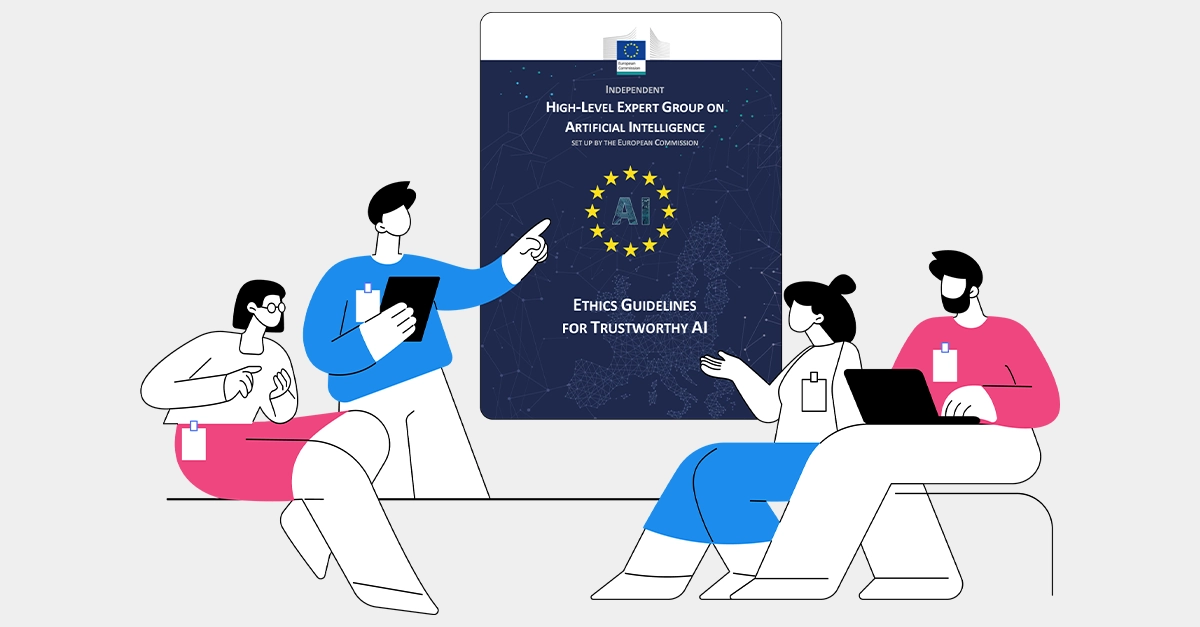
We start by discussing the work of the High-level Expert Group on AI (HLEG on AI), appointed by the European Commission in 2018 to support the implementation of the European strategy on AI. The work provides policy recommendations on AI-related topics. The “Ethics Guidelines for Trustworthy AI”(2019) and its complementary “Assessment List for Trustworthy AI, for Self-Assessment” (2020) are two non-binding texts that can be read as one single framework.
From an AI practitioner’s point of view, the guidelines and the assessment list for trustworthy AI are strategic tools with which companies can build their own policies to ensure the implementation of ethical AI-Systems. In this sense, the work of the HLEG on AI is presented as a generalist model that can/should be adapted to the context of each specific AI-System. Additionally, due to its holistic approach, the framework addresses not only the technological requirements of AI-systems, but also considers all actors and processes involved throughout the entire life cycle of the AI.
As the HLEG on AI states, the guidelines’ “foundational ambition” is the achievement of trustworthy AI, which requires AI-systems, actors and processes to be “lawful, ethical, and robust”. Having said this, the authors explicitly exclude legality from the scope of the document, deferring to the corresponding regulations, and focus on addressing the ethical and robust dimensions for trustworthy AI-systems.
The framework is structured around three main conceptual levels, progressing from more abstract to more concrete. At the top level, defining the foundations of trustworthy AI, four “ethical imperatives” are established, to which all AI systems, actors, and processes must adhere:
At a second level, the framework introduces a set of seven key requirements for the realisation of trustworthy AI. The list is neither exhaustive nor presented in a hierarchical order.
The relevance of these key requirements extends beyond these guidelines. They also inform recital 27 and, implicitly, article 1 of the recently published EU AI Act, of April 2024.
The guidelines suggest a range of technical and non-technical methods for their implementation (e.g., architectures for trustworthy AI, codes of conduct, standardization, diversity and inclusive design) that actors can use to enforce the mentioned requirements.
Achieving trustworthy AI is an ongoing and iterative process that requires continuous assessment and adaptation of the methods employed to implement key requirements in dynamic environments.
The third level of the framework consists of an “Assessment List for Trustworthy AI” (ALTAI), intended to operationalise the key requirements. It is primarily addressed to developers and deployers of AI-Systems that directly interact with users.
The ALTAI list breaks down the key requirements into more concrete categories. It provides a range of self-assessment questions for each of these, aiming to spark reflection around every aspect. Each individual actor is left to decide on the corresponding mitigating measures.
For example, the ethical requirement of Diversity, Non-Discrimination and Fairness, is divided in three subsections:
1) Avoidance of unfair bias
2) Accessibility and Universal Design
3) Stakeholder participation
In turn, for Avoidance of Unfair Bias, a series of self-assessment questions are proposed, a sample of which is listed below:
The guidelines also suggest that companies incorporate their assessment processes into a governance mechanism, involving both top management and operations. The text even proposes a governance model, describing roles and responsibilities.
The assessment list is not intended to be exhaustive and follows a generalist (horizontal) approach. The purpose of the HLEG on AI is to provide a set of questions that help all AI-system actors operationalise the more abstract key requirements, and to encourage them to adapt the assessment list to the specific needs of their sector and continuously update it.
In accordance with this vision, and grounded in the same framework, the European Commission published in September 2022, the “Ethical Guidelines on the Use of AI and Data in Teaching and Learning for Educators”. This document is a valuable resource for teachers and educators, helping them to reflect on AI and critically assess whether the AI systems they are using comply with the Key Requirements for Trustworthy AI.
Having analysed the work of the HLEG on AI, we understand that it is proposed as a framework that companies like Avallain, along with other AI-system deployers, can build upon to create an adapted version that ensures the ethical design, development, and use of AI tools for the educational content creation community.
To this end, we support the framework’s recommendation of establishing a multidisciplinary body within companies to define ethical and robustness standards, identify the corresponding mitigating interventions, and ensure their implementation across all involved areas. This governing body should play a crucial role in the continuous adaptation of the company’s ethics and AI strategy to future ethical challenges.
We established the Avallain Lab in 2023 to be an ethically and pedagogically sound academic resource, providing support to Avallain product designers and partners, as well as the wider e-learning community.
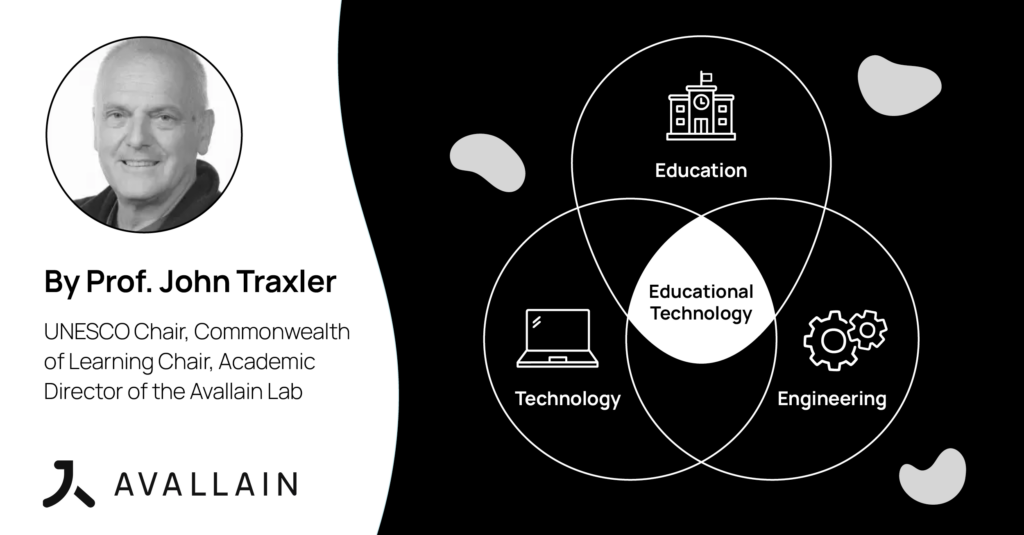
This unit operates under the academic leadership of John Traxler and the business direction of Carles Vidal. The Avallain Lab also has the support of an advisory panel including Professor Rose Luckin. This experience and expertise allows us to deliver research-informed technology and experiences for learners and teachers, including in the field of AI.
The Avallain Lab is a unique, novel and innovative approach acting as the interface between the world’s vast and rapidly evolving research outputs, activities, networks and communities and Avallain’s continued ambition to enhance both the pedagogic and technical dimensions of its products and services with relevant medium-term ideas and longer-term concepts.
The Lab supports Avallain’s trials and workshops, informs internal discussion and draws in external expertise. The Lab is building a library of research publications, contributing to blogs and research papers and presenting at conferences and webinars. Early work focussed on learning analytics and spaced learning but the current focus is artificial intelligence, specifically ethics and pedagogy and their interactions.
Business Director of the Avallain Lab,
MSc in Digital Education by the University of Edinburgh.
Carles Vidal is an educational technologist with more than twenty years of experience in content publishing, specializing in creating e-learning solutions that empower educators and students in K12 and other educational stages. His work has included the publishing direction of learning materials aligned with various curricula across Spain and Latin American countries.
Academic Director of the Avallain Lab,
FRSA, MBCS, AFIMA, MIET
John Traxler, FRSA, MBCS, AFIMA, MIET, is Professor of Digital Learning, UNESCO Chair in Innovative Informal Digital Learning in Disadvantaged and Development Contexts and Commonwealth of Learning Chair for innovations in higher education. His papers are cited over 11,000 times and Stanford lists him in the top 2% in his discipline. He has written over 40 papers and seven books, and has consulted for a variety of international agencies including UNESCO, ITU, ILO, USAID, DFID, EU, UNRWA, British Council and UNICEF.
Advisory Panellist of the Avallain Lab,
Doctor of Philosophy – PhD, Cognitive Science and AI
Rosemary (Rose) Luckin is Professor of Learner Centred Design at UCL Knowledge Lab, Director of EDUCATE, and author of Machine Learning and Human Intelligence: The Future of Education for the 21st Century (2018). She has also authored and edited numerous academic papers.
Dr Luckin’s work centres on investigating the design and evaluation of educational technology. On top of this, she is Specialist Adviser to the UK House of Commons Education Select Committee for their inquiry into the Fourth Industrial Revolution.
Her other positions include:
Education Technology Provider, Avallain, today reaffirmed its commitment to responsible generative AI and innovation in education with a number of key announcements.
Avallain, a twenty year veteran of innovative and impactful edtech, has acquired TeacherMatic, one of Europe’s fastest growing generative AI toolsets for educators. The acquisition supports Avallain’s broader AI strategy including remediation and copyright protection, both features developed for its industry leading content creation tool, Avallain Author.
The Avallain product suite already enables publishers to use the full breadth of the best generative AI while meeting educational, legal and commercial requirements. TeacherMatic has, over the last year, developed and organised one of the most complete AI toolsets to support educators globally, allowing everything from lesson plans and flashcards to schemes of work and multiple choice quizzes – alignable to curricula – at the click of a few buttons. This coming together of TeacherMatic and Avallain forms the basis of a strong partnership of leading-edge and ethical capability applying generative AI for education.
Ursula Suter, Co-Founder and Executive Chairwoman at Avallain, says “We see this joining of forces with TeacherMatic as a crucial step to counter the main risks from generative AI while also benefiting educators and education, in general, in a manner that will cater to high quality educational publishing and learning outcomes. For many years we have been delivering grounded and considered educational innovation. With TeacherMatic, we will continue to do that and more. Our product suite achieves both high-quality education and commercial viability with success for all parties involved.”
Peter Kilcoyne, MD at TeacherMatic comments “TeacherMatic was formed by a group of lifelong educators with the aim of making generative AI available and accessible to all teaching staff to help reduce workloads and improve creativity. We are delighted to have been acquired by Avalllain whose expertise and experience in terms of both education and technology will greatly enhance our future developments, improve TeacherMatic as a platform as well as engaging with new markets around the world. We see the ethical, technical and educational principles that drive both Avallain and TeacherMatic make this a partnership that will benefit both organisations as well as our customers and all teachers and students in organisations that we support.”

Ignatz Heinz (President & Co-Founder), Ursula Suter (Executive Chairwoman & Co-Founder), Alexis Walter (MD), Monika Morawska (COO), Rahim Hirji (Executive VP) © Mario Baronchelli
In an additional announcement, Professor Rose Luckin has been appointed to the advisory board of Avallain. Rosemary (Rose) Luckin is a Professor at University College London and Founder of Educate Ventures Research (EVR) who has spent over 30 years developing and studying AI for Education. She is renowned for her research into the design and evaluation of educational technology and AI.
Rose comments “Avallain has, for many years, been the quality engine of education for publishers and content providers. I am delighted to support them and provide guidance and direction for Avallain’s products as we step forward into this exciting era of AI within education”
Finally, Avallain also officially announced the Avallain Lab, with John Traxler as Academic Director. Traxler holds Chairs from the Commonwealth of Learning for innovations in higher education and from UNESCO for Innovative Informal Digital Learning in Disadvantaged and Development Contexts. The Avallain Lab was incubated in 2023 with a remit to provide research and rigour around product development for partners covering everything from learner analytics and accessibility to ethical AI applicability for learners. The Lab will support Avallain’s current partners and operate commercially in partnership with other institutions exploring innovation in educational contexts – and welcomes global collaborators.
Avallain’s announcements today build upon its established commitment to ethical generative AI, which is already available for Avallain Author, its market-leading content authoring tool and its newly launched SaaS Learning Management System (LMS), Avallain Magnet. Current clients can leverage new tools that can automate parts of the editorial workflow while leaving editors and learning designers firmly in control of the process.
About Avallain
Avallain powers some of the most renowned educational brands including Oxford University Press, Cengage National Geographic Learning, Cambridge University Press, Santillana, Klett, and Cornelsen, reaching millions of learners worldwide. Avallain most recently raised 8M Euros from Round2 Capital Partners and is advised by i5invest. Through the Avallain Foundation, the technology is also made available to partners improving access to quality education.
Find out more at avallain.com
About TeacherMatic
TeacherMatic was formed in 2022 as Innovative Learning Technologies Limited and has developed a suite of generative AI tools for educators. Teachermatic has adoption in FE Colleges in the UK, Universities and Schools and recently partnered with OpenLMS.
Free trials are available at teachermatic.com
For media comment, contact Rahim Hirji, Avallain, rhirji@avallain.com
Contact:
Daniel Seuling
VP Sales & Marketing
dseuling@avallain.com
Richmond Solution has recently been awarded the prestigious ISTE (International Society for Technology in Education) Seal for its commitment to excellence in educational technology. At the heart of the Richmond Solution digital offering are two key Avallain systems: the Avallain Unity custom LMS solution powers the Richmond Learning Platform and Avallain Author is used to create most of Richmond’s digital content.
The ISTE Seal serves as a symbol of high-quality product design for educational solutions that enable and guide exceptional learning. By earning the ISTE Seal, Richmond Solution demonstrates its dedication to best pedagogical practices, effective technology implementation, and alignment with the ISTE Standards. This recognition emphasizes the practical usability, digital pedagogical implementation, and exceptional quality of Richmond Solution’s offerings.
“Richmond and Avallain have been working together since 2008 to build truly innovative digital content delivered on a user-friendly, dynamic learning platform. It is an honour to see this collaboration recognised by a body such as ISTE after undergoing the demanding ISTE Seal process.” Luke Baxter, Digital Publisher at Richmond Publishing.
“We are very proud of the recognition Richmond Solution has received through the prestigious ISTE Seal, which underscores Richmond’s unwavering dedication to excellence in educational technology. Avallain is delighted that Avallain Author, our e-learning authoring tool, and Avallain Unity, our custom LMS solution, played a pivotal role in this endeavour.
Witnessing our collaboration acknowledged by the rigorous ISTE Seal process is a testament to our joint commitment to delivering unique digital education experiences.” Alexis Walter, Managing Director at Avallain.
Lustmühle, December 14, 2022 – Avallain, the award-winning Swiss provider of cutting-edge e-learning and EdTech solutions, which works with leading premium brands worldwide, has succeeded in securing a second growth financing amounting to EUR 8 million from the European investment fund for revenue-based finance and growth financing, Round2 Capital.
The company’s founders Ursula Suter and Ignatz Heinz continue to control the company as majority shareholders. The aim of this funding round is to provide solid support for the company’s strong growth and pace of innovation.
In the pandemic EdTech boom of recent years, Avallain proved itself as a reliably positioned pioneer and long-standing partner to the education world, enjoying considerable growth as a result.
The award-winning EdTech scale-up Avallain, founded in 2002, pursues the mission of unleashing human potential through innovative, technology-enabled education, enabling quality-driven companies and organizations to create and operate highly interactive e-learning solutions. Round2 Capital recognized the company’s great potential as recently as 2020, when it invested a 7-figure amount in the emerging scale-up.
Now, the Vienna-based investment fund and European pioneer in revenue-based finance, which invests in leading technology and software scale-ups in Europe, has further strengthened the partnership and provided another EUR 8 million in growth financing, on a revenue-based basis as well as with a minority equity component, to the Swiss scale-up. Once again, i5invest acted as advisor to Avallain AG and supported the growth financing transaction with Round2 Capital.
The newly raised capital will enable Avallain to introduce product innovation for customers faster and to expand further into existing as well as new markets, beyond the possibilities of its own profits. In doing so, Avallain will continue to provide holistic solutions to the education industry’s greatest challenges and potentials.
These solutions will follow a broader strategy that ensures they are effective, secure, sustainable and innovative, so that Avallain’s customers are one – or even more – steps ahead of their competition, both now and in the future. Furthermore, Avallain will continue to expand its partnerships and ecosystem to enable customers to implement seamlessly into their digital landscape and benefit from new synergies.

The Avallain founders with the leadership team. © Avallain AG
Ursula Suter, Co-Founder Avallain AG:
Based on the recent dramatic increase in demand for edtech during the pandemic, Avallain has once again proven itself as a solid, high-quality provider and reliable partner for end-to-end EdTech solutions. In order to consolidate and expand our leading position internationally in an environment of new entrants that often focus on single challenges rather than holistic solutions, we decided to raise additional funds from a strong partner who understands and appreciates our markets and the high potential we have based on the best-in-class technology and market position we have built over the past years. The previous cooperation with Round2 Capital has been excellent and we are pleased to extend the participation of a growth partner with a philosophy that suits us. With this deal structure, the founders retain control of the company and receive sufficient potential for the next chapter.

Stefan Nagel (c) Markus Schlögl
Stefan Nagel, Managing Partner at Round2 Capital: „We are excited to take the next step in our collaboration with Avallain with this transaction. Avallain’s management team, led by Ursula and Ignatz, has used Round2 Capital’s initial 2020 investment to holistically position the company for growth and has begun rolling out its new SaaS application, Avallain Magnet. Following the successful implementation of these processes, we are pleased to be able to further support this expansion with our funding. Education Technology is one of Round2 Capital’s focus sectors, along with Cybersecurity. Avallain is very well positioned to address the further growth potential of the digitization of education.”
About Avallain | www.avallain.com
Founded in 2002 by EdTech pioneers Ursula Suter and Ignatz Heinz, Avallain is an award-winning Swiss provider of EdTech and eLearning solutions, working with leading brands worldwide. The company’s mission is to unlock human potential through innovative and technology-enabled education. Avallain’s team covers five continents and represents more than 14 nations. The company is an active participant in the UN Global Compact and aims to advance the SDGs by being climate positive from 2023 and contributing to positive social change in sub-Saharan Africa through the Avallain Foundation.
About Round2 Capital Partners | www.round2cap.com
Round2 Capital is a fast-growing European investment fund with €115 million under its management. The Vienna-based company is a strong partner for European scale-ups and companies with digital and sustainable business models. Since its founding in 2017, Round2 Capital has been pioneering revenue-based finance in Europe and is active in several European countries, with a focus on Germany, Switzerland, Austria and the Nordic countries. To date, Round2 Capital has invested in more than 25 different companies. Get in touch
Avallain is delighted to announce a new collaboration with Eaquals, the renowned international accreditation body for providers of language education. Our associate membership offers a unique opportunity to forge meaningful connections with a broad membership of innovative institution, and enables us to pilot products, seek feedback and ideas and share technology and expertise.
Eaquals is an international non-profit membership association, founded in 1991 with the aim of fostering excellence in language education across the world by providing leadership, guidance and support to governments, teaching institutions and individuals. Eaquals is independent of any commercial group and exists solely to serve the interests of language learners and the language education profession.
“We are thrilled to be forming an association with Eaquals,” said Ignatz Heinz, President & Co-Founder of Avallain. “It is a natural extension of our deep connections with language education and our commitment to excellence in the field. Our partnership will facilitate a free exchange of insights and expertise with the exceptional practitioners who make up the Eaquals membership, and the provision of Avallain technologies through piloting and exclusive member arrangements. We look forward to a bright and creative future in the Eaquals family!”
Lou McLaughlin, CEO of Eaquals said: “Eaquals is delighted to welcome Avallain into the Eaquals network as our newest associate member. Avallain’s commitment to delivering the best learning experiences to students and teachers aligns with Eaquals mission to foster excellence in language education and they are a great addition to the Eaquals membership.”
Over the past two decades, Avallain has become the leading technology provider to ELT and educational publishers. Through our white-labeled solutions, we have delivered the very best learning experiences for students and teachers in a range of educational settings. Now, with the release of Avallain Magnet, we have made that unrivaled blend of technology and educational experience available directly to language training organizations of all sizes, whether private language schools, universities or state institutions.
And because Magnet seamlessly combines digital content authoring and learning management features, it offers innovative institutions – such as those that comprise the Eaquals membership – the opportunity to deliver specialist, tailored or own-branded content programmes, helping them to enhance their educational offer and stand out from the crowd.
About Eaquals
Eaquals is an international non-profit membership association. Founded in 1991, we are independent of any commercial group and exist solely to serve the interests of language learners and the language education profession.
About Avallain
Founded in 2002, Avallain is an award-winning Swiss EdTEch and eLearning solutions provider that works with leading premium brands worldwide. The company’s mission is to unlock human potential through innovative technology-enhanced education and to enable businesses and organisations to create highly interactive e-Learning content solutions. Co-founders and EdTech pioneers Ursula Suter and Ignatz Heinz lead the international Avallain team, which spans five continents and has staff members from over 14 countries.
The company is an active participant in the UN Global Compact and aims to advance the SDGs by maintaining a zero-carbon footprint and contributing to positive social change in Sub-Saharan Africa through the Avallain Foundation.
The Eaquals Annual International Conference 2022 will be held this year in Venice, Italy, from 28-30 April, and Avallain will proudly join the exclusive lineup of plenary speakers, with the participation of our own Max Bondi, Head of Product Management. Max will take the stage and discuss ways to ensure resilience and flexibility by transitioning to a truly digitally native school.
For more than ten years, Max has worked extensively with ELT and educational publishers such as Oxford University Press, Cambridge University Press, Pearson, National Geographic
Learning | Cengage, and Santillana Richmond to deliver some of the industry’s most trusted digital solutions, used by millions of learners every day. Now, he is focused on bringing these innovations to the institutional market.
Since the onset of the pandemic, there has been a renewed urgency to engage effectively with digital solutions. And yet, all too often, technology brings complexity. Max will explore ways of simplifying: bringing together self-authored and published language courses, virtual classes, apps, messaging, analytics, e-commerce, and other key features of a successful digital programme in one impactful experience.
During the session, Max will introduce Avallain Author, our powerful online authoring tool, as well as Avallain Magnet, the all-in-one learning management system. Both solutions, fully integrated with each other, bring together powerful features honed for language training, enabling the delivery of truly interactive and engaging online courses. Max will also be joined by Chris Moore, MD of Specialist Language Courses, who will discuss how these solutions have helped his institution to extend its digital offering.
The Eaquals conference traditionally provides a rich programme for centre owners, directors, academic managers, teacher trainers as well as researchers and teachers alike. The 2022 conference programme will cover five main themes:
“Technology has a crucial role to play in delivering powerful learning experiences, but too often this is done without focusing on the core engagement with the learner. How do you harness technological innovation without the technology getting in the way? How do you embed this in an organisation without succumbing to the destructive power of digital disruption? This is the problem that Avallain Magnet solves. I look forward to a lively discussion with a set of influential practitioners the like of which only Eaquals can bring together” said Max Bondi, Head of Product Management at Avallain.
Make sure to come to Spazio 3 at 2:00 PM CEST, Saturday 30 April, at the NH Venezia Laguna Palace in Mestre, Venice, where the Eaquals Annual International 2022 conference will be held.
Max Bondi (mbondi@avallain.com) and Ignatz Heinz (iheinz@avallain.com), our President and Co-Founder, are just an email away if you would like to meet them and chat during the conference.
About Eaquals
Eaquals is an international non-profit membership association. Founded in 1991, we are independent of any commercial group and exist solely to serve the interests of language learners and the language education profession.
About Avallain
Founded in 2002, Avallain is an award-winning Swiss EdTEch and eLearning solutions provider that works with leading premium brands worldwide. The company’s mission is to unlock human potential through innovative technology-enhanced education and to enable businesses and organisations to create highly interactive e-Learning content solutions.
Co-founders and EdTech pioneers Ursula Suter and Ignatz Heinz lead the international Avallain team, which spans five continents and has staff members from over 14 countries.
The company is an active participant in the UN Global Compact and aims to advance the SDGs by maintaining a zero-carbon footprint and contributing to positive social change in Sub-Saharan Africa through the Avallain Foundation.
Avallain is delighted to announce the first certifications awarded under the brand new Avallain Author Training & Certification Programme.
Those recognised include dozens of independent freelance editors, writers and publishing professionals, along with the content team of Weblink Software, which becomes the first Avallain Author Certified Team. All trainees have completed an extensive six-hour self-study course and a certification module, which assesses both acquired knowledge and practical skills. Certified professionals and teams are able to demonstrate and promote their Avallain Author skills to the wider industry, opening up opportunities to work on the hundreds of projects delivered on Avallain Author each year by clients such as Oxford University Press, Pearson, Cambridge University Press, Santillana and Cengage.
Avallain Author has become the central digital content creation tool in the education industry. The new Training & Certification Programme ensures that content professionals — whether in-house or out-of-house — have an excellent foundation in the many capabilities of Avallain Author and are able to demonstrate their skills to colleagues, publishers and institutions. In addition, by certifying at least 5 team members and retaining their own Author licence, content service providers and publishers can now achieve Avallain Author Certified Team status. Weblink Software is the first to be recognised with a team certification.
“As a key provider of content creation services to the educational publishing industry, Weblink Software is delighted to become the very first Avallain Author Certified Team,” said Gavan Tanham, Chairman of Weblink Software. “Given the important role that Avallain Author plays in the industry, our team’s certification will allow us to provide and promote our services more widely, and assure our clients that their digital projects are in excellent hands.”
Many of the first content professionals to become certified are English Language Teaching specialists and can be found via an accreditations search in the ELT Publishing Professionals directory, developed in collaboration with Avallain.
Ignatz Heinz, President and Co-Founder of Avallain said: “We have always wanted to make our Avallain Author training available to all professionals and teams – in-house or out-of-house – and to provide certification so that they can demonstrate their capabilities. These first certifications offer our clients and their providers exciting new opportunities to work together in Avallain Author, secure in the knowledge that they have all the skills needed to create groundbreaking, powerful educational content. Congratulations to all!”
Avallain is an award-winning Swiss EdTEch and eLearning solutions provider that works with leading premium brands worldwide. The company’s mission is to unlock human potential through innovative technology-enhanced education and to enable its clients to create highly interactive e-Learning content solutions.
Weblink Software is a complete content service provider for the ELT industry, transforming print-based content for delivery in online platforms. Trusted by the biggest publishers and the first team to be certified by Avallain, Weblink provides a hassle-free and constructive workflow to create high-quality digital outcomes.
ELT Publishing Professionals is a dynamic online directory specialised in helping ELT and educational publishers hire freelancers with the right skills, experience and accreditations for their outsourced projects. ELTpp’s CPD programme includes input from Avallain, and together they have developed a filter for publishers to find Avallain-accredited freelancers.
Avallain Author was created over 15 years ago with the intention of establishing the most powerful and flexible digital authoring tool available to educational content creators. Over the years, it has evolved to be the central technology used by the industry, benefitting from real-world-use with educational publishers throughout the world.
Avallain Author now provides unrivalled support for diverse content formats, use-cases, workflows and modes of learning, resulting in more than 8.5 million interactive content items – all of them developed by our clients. The more it has been used by real content creators and deployed at scale, the more sophisticated Avallain Author has become.
To keep pace with the many developments in Avallain Author, Avallain has evolved its customer support and training, ensuring that clients are able to make the best use of the tool and achieve truly unique, vibrant and impactful learning experiences.
Given the many collaborations that happen in content creation, this training should be available to everyone, from in-house editorial staff, to authors, freelancers, and content service providers. And they should have a reliable and recognised way to demonstrate their Avallain Author knowledge and skills.
This brand-new programme combines a 6-hour video-led training course and a 2-hour certification module. Everything is delivered on Avallain’s powerful learning platform, Avallain Magnet, meaning that the course can be completed in the trainee’s own time and on any device. It includes sandboxed access to Avallain Author itself, so that trainees can practise all they have learned and establish a lasting set of skills.
Trainees and teams that complete the training and pass the final test receive a digital certificate and badge that can be easily displayed on profiles, directories, and websites. This ensures that Avallain Author and Avallain Magnet clients are able quickly to identify skilled Author professionals and companies to help with their content programmes.
Dozens of professionals and a number of content service providers are already on their way to becoming Avallain Author certified, and upcoming cohorts are already scheduled, with seats still available.
Those interested in joining this unique programme can visit the registration page to find more information about how to get certified on one of the most powerful and popular authoring tools in the world.