Responsibly Adopting AI in Language Education

For the final episode of 2025, the Language Teaching Takeoff Webinar Series brought together experts from across language education and edtech to examine how AI can be adopted responsibly in teaching practice.

Responsibly Adopting AI in Language Education

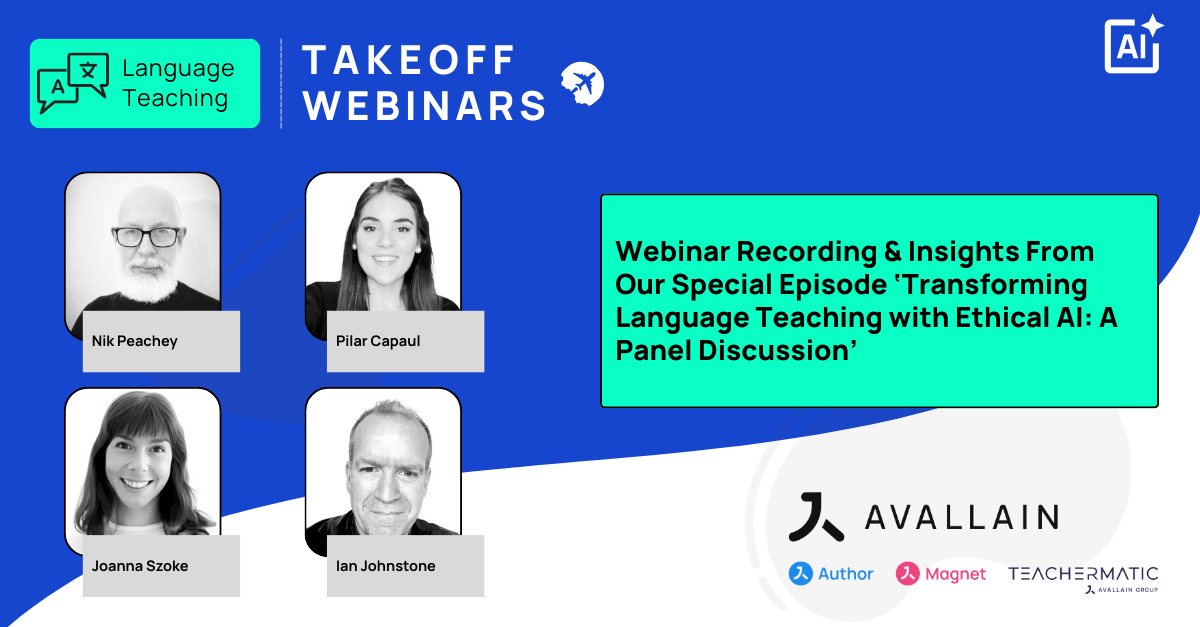
London, December 2025 – In ‘Transforming Language Teaching with Ethical AI: A Panel Discussion’, educator and edtech consultant Nik Peachey, teacher and ELT content creator Pilar Capaul, teacher trainer and lecturer Joanna Szoke, and Ian Johnstone, VP Partnerships at Avallain, discussed ethical considerations, institutional responsibility and practical ways to integrate AI with confidence.

Moderated by Giada Brisotto, Senior Marketing and Sales Operations Manager at Avallain, the session examined how AI toolkits, such as the TeacherMatic Language Teaching Edition, can be used in teaching practice to improve efficiency without diminishing teacher agency.

The Potential and Advantages of AI in Language Teaching

Opening the discussion, Nik identified time as one of the most persistent challenges for language teachers, from marking and lesson planning to adapting materials for specific classroom contexts. He noted that while coursebooks provide structure, they are often designed for global audiences and may not fully reflect the needs of individual learners.

Nik explained that AI can help teachers adapt and extend materials more efficiently, supporting personalisation without adding complexity. He referenced AI toolkits such as the TeacherMatic Language Teaching Edition, where generators and CEFR-aligned inputs reduce reliance on prompt-writing skills and support differentiation, especially for learners with diverse needs.

From a teacher training perspective, Joanna reinforced this point by highlighting speed and responsiveness as key advantages. She explained how AI tools enable teachers to generate resources for niche teaching contexts and specific learner profiles, allowing educators and trainers to focus more on pedagogy and professional reflection rather than on content production.

AI in the Classroom: Practical Examples that Move Beyond Content Creation

Drawing on classroom experience, Pilar discussed how AI-generated activities can serve clear learning purposes rather than simply producing content.

Using TeacherMatic generators like ‘Have you done your homework’, she replaces a simple homework check with a diagnostic warm-up that reveals whether learners have truly understood a task, enabling her to decide how the lesson should progress and where support is most needed.

To make reading more purposeful, the ‘Ask an Expert’ generator prompts learners to read with intent, question information and evaluate meaning rather than read passively.

The Role of Education Technology Providers in Ethical AI Adoption

Shifting the discussion to institutional responsibility, Ian noted that education technology companies must ensure AI does not begin to lead educational practice. While new capabilities may appear compelling, he stressed that decision-making should remain educator-led, with tools designed to support teaching rather than dictate it.

Ian highlighted the importance of sustained research, classroom piloting and collaboration with educators and institutions to refine how AI is deployed in practice. He also emphasised the role of providers in sharing what they learn through structured guidance and training, empowering teachers and organisations to build confidence, develop informed approaches and navigate the broader shift AI is bringing to language education.

Where Does AI Add the Most Value for Language Teachers

The benefits of AI depend primarily on what teachers need to achieve. Joanna explained that for planning and administrative work, it can reduce time spent on tasks such as drafting reports or lesson outlines, provided teachers remain attentive to the data they share and treat outputs as a starting point rather than a final version. At the same time, she strongly argued for classroom use, where working with AI alongside students creates opportunities to model critical evaluation, ethical decision-making and responsible use, helping learners understand not just how to use these tools but also how to question them.

Ian reaffirmed that responsibility cannot sit solely with teachers. He added that education technology companies must take an active role in designing safeguards into AI toolkits, using clear interface guidance to discourage inappropriate use and implementing measures that reduce the risk of sensitive data being shared. By embedding these considerations at both the practical and systemic levels, edtech providers can ensure ethical use is built in by design, rather than relying on individual educators to navigate these challenges on their own.

Getting Started with AI in Daily Practice

Nik encouraged teachers to start small and let curiosity guide their first steps, suggesting they focus on a single area, such as planning, feedback or material creation, rather than trying to do everything at once. He advised identifying everyday pain points and using AI as a conversational partner to explore possible approaches. At the same time, Joanna added that teachers should not overcomplicate the process, noting that simple questions and natural interaction are often the most effective way to begin building confidence.

Ethics, Transparency and Authentic Classroom Use

Returning to the ethics question, Ian stressed the importance of preserving the dialogic nature of learning, ensuring that interaction remains a meaningful exchange rather than a one-way output. He explained that TeacherMatic is designed as an educational AI toolkit, with a built-in chat environment and filters that set clear boundaries for what can be shared and generated in a learning context, reducing the risk of inappropriate content or data misuse. 

At an organisational level, Ian highlighted Avallain’s responsibility to underpin this work through ongoing research conducted by a dedicated lab, where academic expertise focuses on ethical frameworks, regulatory developments and the broader implications of AI use, including environmental impact. Together, these layers ensure that safeguards are embedded by design and continuously reviewed as technology evolves.

From a classroom perspective, Pilar examined how authenticity is maintained when AI-generated materials are shaped around real learners. Using the TeacherMatic AI toolkit, she highlighted the use of generators such as ‘Inspiration!’ and ‘Adapt your Content’ to create multiple versions of activities on the same topic. This allows students to work at an appropriate level, feel recognised and engage more confidently, reinforcing that AI-generated materials remain meaningful only when guided by teacher insight and an understanding of learner context.

Assessment, Exam Preparation and the Limits of Automation

Joanna addressed the use of AI in assessment by drawing a clear distinction between formative and summative contexts. For formative assessment, she highlighted the value of AI in generating feedback and action points to support ongoing learning, while emphasising the need for professional judgement. In summative contexts, she noted that although automated scoring can play a role for specific task types, final decisions should remain with the teacher, adding that when working with AI, ‘I will be curious and cautious.’

Building on this, Ian reinforced that generative AI should not be positioned as a decision-maker in summative assessment. He explained that language models form a new understanding each time they evaluate a piece of work and do not draw on the accumulated experience of a trained language teacher. As a result, they can offer multiple, variable interpretations rather than a consistent, auditable evaluation. For summative contexts, he argued, there should always be a role for teacher review and moderation, noting that only rule-based, algorithmic approaches, where assessment criteria are explicitly defined and auditable, may be appropriate for high-stakes decisions.

Looking at day-to-day teaching, Pilar drew on her experience preparing learners for international exams, particularly teenagers who may feel disengaged or under pressure. She explained how the rollout of the TeacherMatic ‘Cambridge Style Exam Prep Generator’ has enabled her to personalise exam-style activities around familiar topics, helping sustain motivation while maintaining relevance. Working in a bilingual setting with varying proficiency, she also described how creating resources on the same content at different levels enabled all students to prepare together while still working at a level that felt appropriate and achievable.

Looking Ahead: Supporting Teachers as AI Tools Evolve

AI toolsets will increasingly become multimodal, enabling teachers to generate audio, images, video and presentations alongside text. Nik noted that this could significantly reduce the time teachers spend searching for suitable media, allowing them to create more stimulating, multimedia-rich lessons and adapt more easily to online or blended learning environments.

Ian expanded on this by placing these developments within a broader roadmap for educational AI. While TeacherMatic already supports the creation of worksheets and lesson plans, he explained that interactive learning experiences are the next step. Drawing on Avallain’s background in interactive content, he outlined how integrating generative capabilities with interactive courseware will enable teachers to deliver more engaging activities and assignments directly in the classroom, rather than treating interactivity as a separate layer.

Joanna emphasised that technology alone is not enough. She stressed the importance of building teacher confidence and critical awareness, encouraging educators to experiment, ask questions and practise with AI tools while remaining alert to hype. Maintaining professional judgement, she argued, means staying attentive to how outputs are generated and preserving a healthy distance between automated suggestions and pedagogical decision-making.

Ethical Adoption as a Shared Responsibility

The value of AI in language education depends on how thoughtfully it is adopted. When pedagogy leads, and professional judgement remains central, AI toolkits, such as TeacherMatic, can empower teachers to manage their workload, design purposeful learning activities and respond more effectively to diverse learner needs.

At the same time, ethical adoption requires shared responsibility. Teachers need space to experiment critically and build confidence, while education technology providers must ensure safeguards, transparency and ongoing research are embedded by design. 

Explore the TeacherMatic Language Teaching Edition

The TeacherMatic Language Teaching Edition is an AI toolkit specifically designed for language educators. Through its purpose-built AI generators, teachers can create activities, support planning, approach assessment and more with greater consistency and control, while reducing time spent on routine tasks.

Discover more here

Next in the Webinar Series:

Create Dynamic and Engaging Exam Practice for Your Students

🗓 Thursday, 22nd January
🕛 12:00 – 12:30 GMT | 13:00 – 13:30 CET

The next edition of the Language Teaching Takeoff Webinar Series will welcome Joanna Szoke. A freelance teacher trainer and AI in education specialist, she will open the new year with a practical session focused on exam preparation.

Her first episode will demonstrate the ‘Cambridge Style Exam Prep Generator’ within the TeacherMatic Language Teaching Edition, alongside other generators designed for assessment-focused use. The session will explore how teachers can create engaging exam-style practice, adapt tasks to different learner needs and approach assessment in ways that support confidence and progression.

Click here to register and secure a spot


About Avallain

For more than two decades, Avallain has enabled publishers, institutions and educators to create and deliver world-class digital education products and programmes. Our award-winning solutions include Avallain Author, an AI-powered authoring tool, Avallain Magnet, a peerless LMS with integrated AI, and TeacherMatic, a ready-to-use AI toolkit created for and refined by educators.

Our technology meets the highest standards with accessibility and human-centred design at its core. Through Avallain Intelligence, our framework for the responsible use of AI in education, we empower our clients to unlock AI’s full potential, applied ethically and safely. Avallain is ISO/IEC 27001:2022 and SOC 2 Type 2 certified and a participant in the United Nations Global Compact.

Contact:

Daniel Seuling

VP Client Relations & Marketing
dseuling@avallain.com

Develop Empowered Communicative Learners with Safe and Accurate AI Tools

The latest Language Teaching Takeoff Webinar showcased four powerful TeacherMatic Language Teaching Edition generators that can transform speaking lessons and foster confident, capable communicators.

Develop Empowered Communicative Learners with Safe and Accurate AI Tools

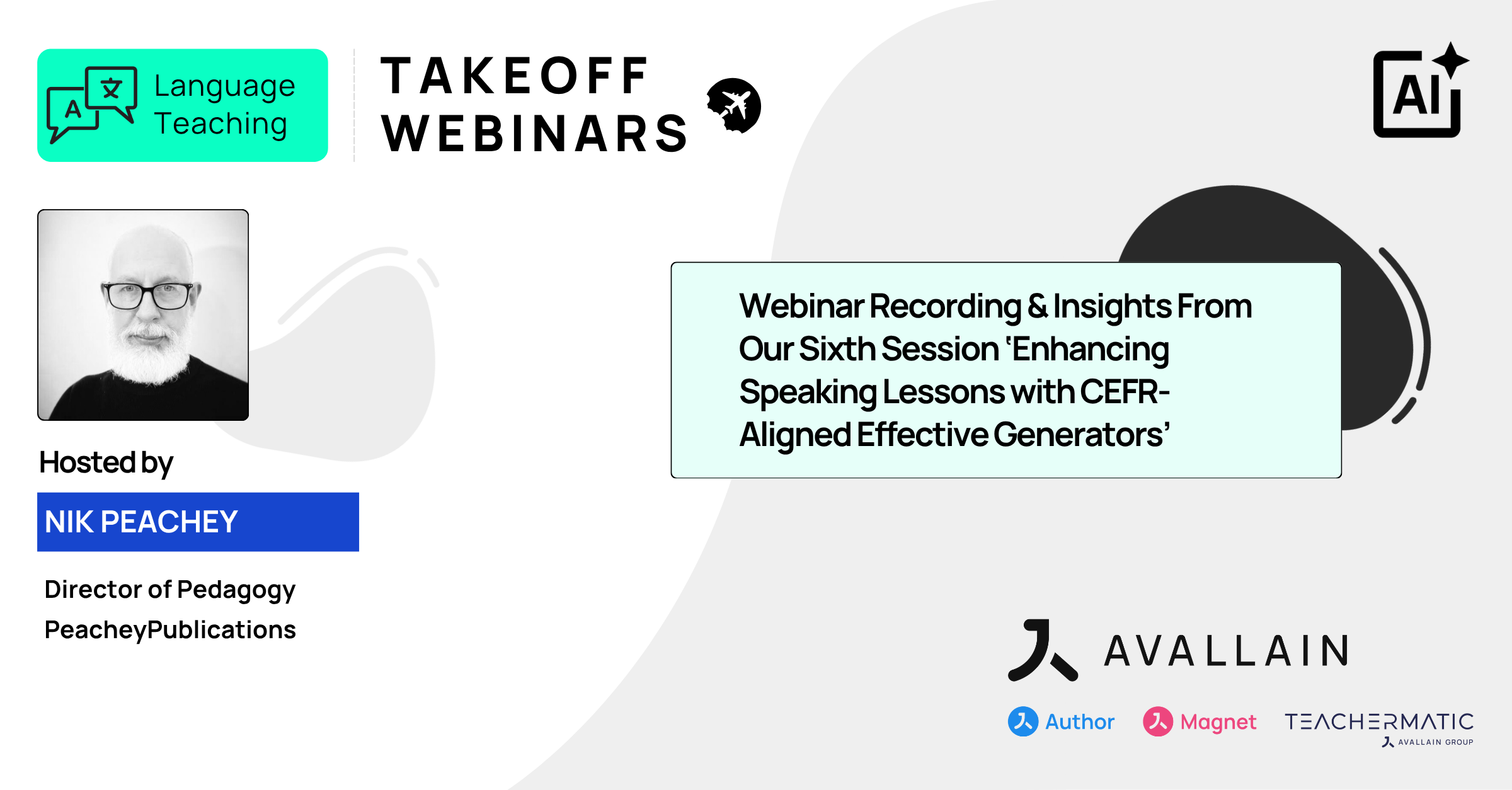
London, October 2025 – In last week’s webinar, ‘Enhancing Speaking Lessons with CEFR-Aligned Effective Generators’, we explored how teachers can use safe and accurate AI tools to help students engage, express ideas, think critically and build confidence in speaking. Pedagogy expert and award-winning educator Nik Peachey demonstrated how the generators can be filtered by skill, selecting ‘Speaking’ to highlight key tools suitable for developing speaking activities. He then guided participants through four effective generators: Dialogue Creator, Differing Opinions, Debate and Discussion Topics

Moderated by Giada Brisotto, Senior Marketing and Sales Operations Manager at Avallain, the session illustrated how these AI generators can transform lessons into interactive, thought-provoking experiences.

Formal vs Informal Speaking Practice

As learners develop their speaking skills, it’s essential to help them adapt to diverse speaking contexts, which is key to building confident communicators. Nik firstly highlighted the importance of formal and informal practice with the Discussion Topics and Debate generators. 

The Discussion Topics generator creates stimulating, level-appropriate conversations. It produces meaningful and engaging discussions for learners at any level, whether A1 or C1. Teachers can include optional supporting materials to tailor activities to students’ current knowledge, creating relevant and interactive interactions.

For more structured interactions, the Debate generator creates authentic, formal debate scenarios. Students can practise precise language and persuasive techniques while gaining confidence in presenting their ideas in a formal setting.

Combine Reading and Speaking

Building on the effective Debate and Discussion Topics generators, which enable teachers to create meaningful, level-appropriate speaking activities, Nik Peachey then introduced and demonstrated the Differing Opinions generator.

Designed to bridge reading and speaking, this generator enables teachers to create activities encouraging learners to analyse viewpoints, express ideas and engage in structured, reflective discussions. By producing balanced arguments on any chosen topic, it empowers students to develop both reasoning and communication skills, leading to richer classroom interactions and deeper engagement with language.

Developing Confident Opinions

The Differing Opinions generator allows teachers to generate multiple perspectives on a single topic, which students can read, compare and respond to. This creates opportunities for learners to evaluate ideas, express agreement or disagreement and justify their opinions using targeted language. The exercise builds confidence in articulating thoughts and helps students develop persuasive and analytical language skills in a supportive classroom setting.

Task-Based Learning

Nik demonstrated how the generator can be integrated into task-based learning. Learners can read a set of opinions, discuss them in groups, record their responses and later reflect on how they expressed themselves. This process reinforces fluency, encourages critical thinking and helps students refine their communication skills through repetition and reflection. Teachers can regenerate or adapt results to better suit different learning levels, and keep activities dynamic and relevant.

Context-Based Dialogue

Continuing the focus on developing authentic speaking skills, Nik introduced the Dialogue Creator generator. Designed to imitate real communication, it allows teachers to produce natural conversations based on specific contexts, vocabulary and CEFR levels. By tailoring prompts and length, educators can generate dialogues that mirror realistic scenarios, helping learners practise fluency, pronunciation and interaction in a safe environment.

Nik discussed how to get the best out of this generator by using it for controlled speaking practice, exploring nuances in language use, building dialogues and producing localised results.

Controlled Practice

The Dialogue Creator produces ready-to-use scripts that help students refine pronunciation, rhythm and natural flow, gradually gaining confidence in real communication. Teachers can also generate listening versions so learners can identify intonation and stress patterns within authentic exchanges.

Nuances in Speaking the Language

Learners can bring these dialogues to life through dramatic or calm readings, encouraging expression and emotional depth. This approach helps students recognise subtle differences in tone, register and emphasis, developing awareness of how meaning shifts through delivery.

Dialogue-Build Exercises

To make activities more interactive, Nik suggested adapting generated dialogues into dialogue-building exercises by removing selected words or phrases. This technique encourages learners to recall vocabulary, complete sentences in context and reinforce language retention through repetition.

Produce Localised Results

Adding supporting materials or regional references allows teachers to generate localised dialogues that reflect cultural and linguistic nuances. These realistic contexts make lessons more relevant and help learners connect language with authentic, everyday communication.

Foster Confident, Capable Communicators in Your Classroom 

Speaking is one of the most rewarding aspects of learning a language for both the student and teacher. Nik’s demonstration of the Discussion Topics, Debate, Differing Opinions and Dialogue Creator generators showcases how the TeacherMatic Language Teaching Edition provides teachers with reliable, CEFR-aligned tools. By streamlining the creation of tailored speaking activities, these AI tools allow educators to focus on facilitating learning, while students develop into articulate, confident and critically engaged communicators.

Explore the TeacherMatic Language Teaching Edition

The TeacherMatic Language Teaching Edition provides a comprehensive suite of tools that empower educators to design, create and deliver high-quality, differentiated speaking lessons efficiently. It uses CEFR-aligned generators to support meaningful, engaging practice across diverse teaching contexts.

Discover more here

Next in the Webinar Series

Beyond the Classroom: Empowering Every Role in Language Education

 🗓 Thursday, 13th November
🕛 12:00 – 12:30 GMT | 13:00 – 13:30 CET

In the next Language Teaching Takeoff webinar, discover generators specifically designed for leaders and administrators. Learn how to streamline planning, support staff and maintain high-quality CEFR-aligned language programmes across your institution.

Click here to register and secure a spot


About Avallain

For more than two decades, Avallain has enabled publishers, institutions and educators to create and deliver world-class digital education products and programmes. Our award-winning solutions include Avallain Author, an AI-powered authoring tool, Avallain Magnet, a peerless LMS with integrated AI, and TeacherMatic, a ready-to-use AI toolkit created for and refined by educators.

Our technology meets the highest standards with accessibility and human-centred design at its core. Through Avallain Intelligence, our framework for the responsible use of AI in education, we empower our clients to unlock AI’s full potential, applied ethically and safely. Avallain is ISO/IEC 27001:2022 and SOC 2 Type 2 certified and a participant in the United Nations Global Compact.

Contact:

Daniel Seuling

VP Client Relations & Marketing
dseuling@avallain.com

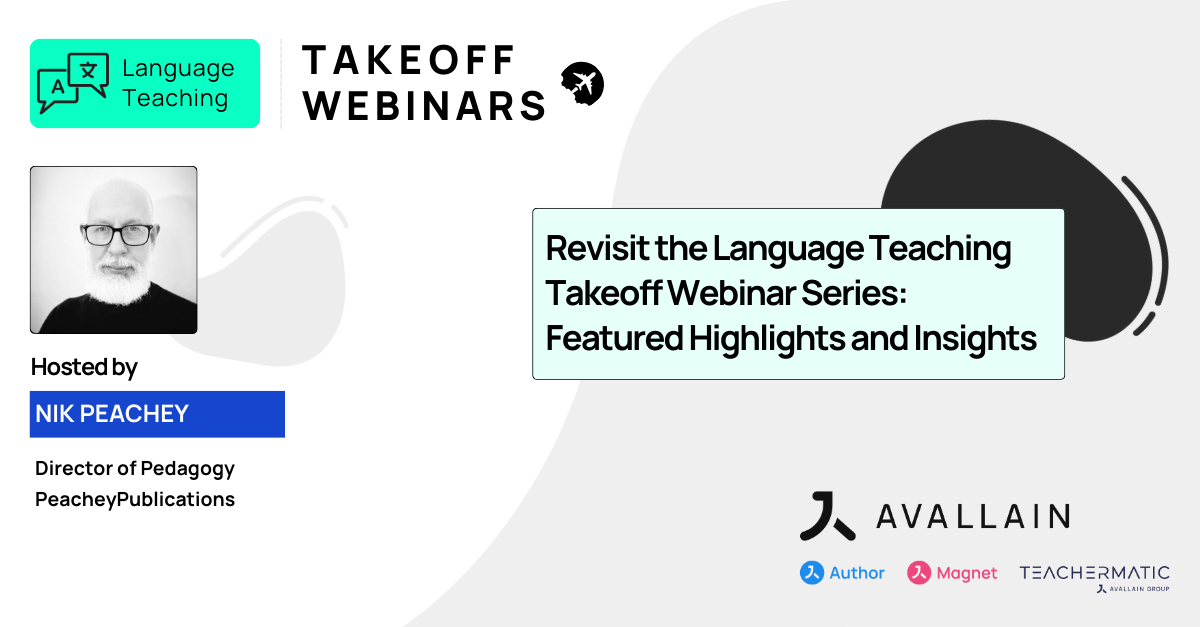
Revisit the Language Teaching Takeoff Webinar Series: Featured Highlights and Insights

While taking a short summer break, we wanted to pause and review the best moments and most important insights from our Language Teaching Takeoff Webinar Series. If you missed an episode or want to revisit the practical tips and tools demonstrated in the TeacherMatic Language Teaching Edition, this blog highlights key takeaways and illustrates how a purpose-built AI supports language educators and enhances classroom practice.

Revisit the Language Teaching Takeoff Webinar Series: Featured Highlights and Insights

London, August 2025 – The Language Teaching Takeoff Webinar Series offers a practical look at the TeacherMatic Language Teaching Edition, a toolkit designed specifically for language educators. It’s more than a generic AI solution: every generator is built around the realities of classroom teaching, with a focus on saving time, enhancing creativity, maintaining pedagogical standards and ensuring the ethical and safe adoption of AI in language education. 

This edition of TeacherMatic can generate comprehensive lesson plans, adapt texts and tasks, create original content and quizzes, provide personalised feedback and more, all tailored to different CEFR levels. Each 30-minute session focuses on integrating AI meaningfully and responsibly, providing ideas, activities and workflows that make a real difference to teaching and learning.

The series has attracted over 300 educators across four sessions, underscoring the strong interest in practical, teacher-focused AI solutions.

Meet the Hosts

Moderated by Giada Brisotto, Senior Marketing and Sales Operations Manager at Avallain, and led by Nik Peachey, award-winning educator, author and edtech consultant, each webinar combines deep expertise with actionable guidance. 

‘These generators aren’t just text tools. They’re designed with real classroom needs in mind. You input your goals, level and theme, and the results are ready to use or refine.’ – Nik Peachey, Director of Pedagogy, PeacheyPublications

Save Time While Planning Quality Lessons

The first webinar in the series, Elevate Your Lesson Planning’, explored how purpose-built AI can transform how teachers design lessons. One of the main insights from the session was the critical balance between efficiency and academic rigour. Nik demonstrated how the Lesson Plan generator enables educators to produce fully structured, CEFR-aligned lesson plans in just a few minutes. 

Key benefits highlighted in the session included:

  • CEFR-aligned outputs to ensure lessons meet recognised language standards.
  • Adaptable and editable plans that reflect the needs of individual classes.
  • Support for professional autonomy, giving teachers control instead of imposing rigid templates.
  • Support for core pedagogical models, including Communicative Language Teaching (CLT), Task-Based Learning (TBL), Presentation Practice Production (PPP), Lexical Approach and Test-Teach-Test.

The session emphasised that the real value of AI in education lies in targeted, purposeful support, rather than blanket automation. Starting with focused applications like lesson planning allows educators to make small, practical changes that can significantly impact both teaching quality and learners’ experiences.

Deliver Personalised CEFR-Aligned Feedback

The second webinar, From Rubrics to Results: How to Provide Impactful Feedback’, focused on how AI can help teachers provide meaningful, personalised feedback without adding to their workload. Nik demonstrated the Feedback generator, showing how educators can instantly create feedback tailored to each student while keeping them aligned with CEFR standards and institutional rubrics.

Key benefits highlighted in the session included:

  • CEFR-aligned feedback that can be tailored to specific subscales.
  • Feedback tailored to rubrics and assessment criteria, ensuring comments reflect your teaching context.
  • Balanced, constructive comments that highlight both strengths and areas for improvement.

During the session, it was stressed that AI works best when it enhances teacher expertise rather than replacing it. By streamlining the feedback process, educators can maintain high standards of personalisation and pedagogy, even with large groups of students.

Adapt and Analyse Content Across Levels

The third webinar, Adapting Content for Effective CEFR-Aligned Language Teaching’, spotlighted how AI can empower teachers to adapt existing materials to diverse learner groups and levels. Nik introduced two powerful tools specifically designed with classroom realities in mind: the Adapt your content generator and the CEFR Level Checker.

Key benefits highlighted in the session included:

  • Effortlessly adapting content from one CEFR level to another while preserving the original theme and ensuring the result is pedagogically effective.
  • Immediate, precise CEFR analysis of texts, breaking down vocabulary and grammar complexity to help verify learner-appropriate materials.
  • Supporting teacher control through editable outputs that can be fine-tuned for specific class needs.

As Nik emphasised, ‘It’s not just about saving time. It’s about creating something that actually works for your learners faster’. The session showed how these AI generators translate the complexity of CEFR adaptation into practical, editable resources, enabling teachers to respond precisely to different learner needs without compromising pedagogical integrity.

Engage Students and Assess Progress Quickly

Generate, Engage and Assess: Create Custom Texts and Multiple Choice Quizzes’, demonstrated how TeacherMatic can support both content creation and assessment in language teaching. Participants saw how the Create a text and Multiple Choice Questions generators allow teachers to produce original CEFR-level texts and assess learner understanding instantly, without prompt engineering or technical complexity.

Highlights from the session included:

  • Generating original classroom-ready texts tailored by topic, CEFR level, grammar focus, text type, vocabulary and length.
  • Creating CEFR-aligned multiple-choice quizzes from any text to assess comprehension, vocabulary or grammar.
  • Adapting content across proficiency levels while preserving the theme and ensuring pedagogical usefulness.

In this session, participants learned how combining flexible content and quiz generators can streamline lesson preparation, enhance learner engagement and support accurate, timely assessment.

The Language Teaching Takeoff Webinar Series has illustrated how purpose-built AI can support language educators in practical, impactful ways. The TeacherMatic Language Teaching Edition allows teachers to leverage AI responsibly, ethically and safely, enhancing learning while maintaining pedagogical standards and putting educators in control of their classroom practice.

The series isn’t over yet.


What’s Next:

After a short summer break, the Language Teaching Takeoff Webinar Series returns. Join us for the next session:

Create Engaging Materials from YouTube Content and Build Custom Glossaries

Date: Thursday, 11th September

Time: 12:00 – 12:30 BST | 13:00 – 13:30 CEST

Secure your place

Discover how AI generators can turn YouTube videos into engaging content, and learn how to generate custom glossaries tailored to CEFR levels and your learners’ needs.


Explore the Language Teaching Edition of TeacherMatic

Whether teaching A1 learners or guiding advanced students through C1 material, the Language Teaching Edition of TeacherMatic helps you do it more efficiently, precisely and flexibly. 

Explore it here


About Avallain

At Avallain, we are on a mission to reshape the future of education through technology. We create customisable digital education solutions that empower educators and engage learners around the world. With a focus on accessibility and user-centred design, powered by AI and cutting-edge technology, we strive to make education engaging, effective and inclusive.

Find out more at avallain.com

About TeacherMatic

TeacherMatic, a part of the Avallain Group since 2024, is a ready-to-go AI toolkit for teachers that saves hours of lesson preparation by using scores of AI generators to create flexible lesson plans, worksheets, quizzes and more.

Find out more at teachermatic.com

Contact:

Daniel Seuling

VP Client Relations & Marketing
dseuling@avallain.com

From Rubrics to Results: Making Feedback More Impactful with AI in Language Teaching

Delivering impactful feedback can be one of the most time-consuming parts of language teaching. In this chapter of the Language Teaching Takeoff Webinar Series, we explored how to streamline the feedback process without compromising the quality that learners deserve.

From Rubrics to Results: Making Feedback More Impactful with AI in Language Teaching

London, May 2025 – On May 15th, the Avallain Group hosted the second session in its Language Teaching Takeoff Webinar Series, ‘From Rubrics to Results: How to Provide Impactful Feedback’. The session was moderated by Giada Brisotto, Senior Marketing and Sales Operations Manager at Avallain, and led by Nik Peachey, educator, author and edtech consultant. 

This 30-minute session focused on how the Feedback Generator in the TeacherMatic Language Teaching Edition can assist educators in providing better, faster and more personalised feedback.

The Challenge: High-Quality Feedback Takes Time

Feedback is essential for student progress, but for teachers, it often comes at the cost of time and energy. Nik opened the session by acknowledging this widespread issue and proposing a practical, AI-supported solution: the Feedback Generator.

Unlike general-purpose tools, the TeacherMatic Feedback Generator, designed specifically for language teaching, allows educators to produce constructive feedback that aligns with assignment briefs, CEFR levels and specific pedagogical approaches.

Personalised Feedback at Scale

Nik demonstrated how the Feedback Generator makes it possible to maintain personalisation, even with large groups of students. By inputting a student’s response and the original task prompt, teachers can instantly generate comments that are:

  • Aligned with CEFR levels and subscales. (e.g., B1 writing > coherence and cohesion)
  • Tailored to the assessment criteria or rubric used by the teacher or institution.
  • Balanced between strengths and areas of improvement.

​​The result: fast, personalised and pedagogically relevant feedback.

Designed for Language Teachers, Not Just Generic Use

As it is purpose-built for language educators, the Feedback Generator supports core pedagogical models including:

  • Communicative Language Teaching (CLT)
  • Task-Based Learning (TBL)
  • Presentation Practice Production (PPP)
  • Lexical Approach
  • Test – Teach – Test

This flexibility allows teachers to generate feedback that fits their existing lesson models and institutional standards.

From Feedback to Feedforward

Nik emphasised that effective feedback not only reflects on the past but also guides learners as they progress. The Feedback Generator enables this by including next steps and actionable guidance in the comments, which can be adjusted for tone, focus and complexity.

This ‘forward approach’ aligns with current thinking in language assessment, that feedback should help students take ownership of their progress and better understand learning objectives.

Why It Matters: Lighter Workload, Deeper Impact

The session closed with a powerful reminder: when tools are designed around the real needs of teachers, not just general AI capabilities, they can genuinely reduce pressure without lowering standards.

By using the Feedback Generator, teachers can:

  • Save time without sacrificing quality
  • Ensure consistency in grading
  • Focus more on student support and less on repetitive admin
  • Promote deeper engagement with learning goals

What’s Next in the Series?

The Language Teaching Takeoff Webinar Series continues in June with ‘Adapting Content for Effective CEFR-Aligned Language Teaching’. You can reserve your seat now. This is a free webinar, but spaces are limited.

Save the Date:

  • Thursday, 12th June
  • 12:00 – 12:30 BST | 13:00 – 13:30 CEST

Register now for the webinar


Discover the TeacherMatic Language Teaching Edition

The Language Teaching Edition of TeacherMatic has been purpose-built to elevate language teaching and learning through sector-specific features designed for real classroom needs. With CEFR-aligned AI generators and support for key pedagogical models such as CLT, Task-Based Learning, PPP and more, it empowers language educators to create high-quality, personalised content efficiently and confidently.

Visit the dedicated landing page to explore all features in depth


About Avallain

At Avallain, we are on a mission to reshape the future of education through technology. We create customisable digital education solutions that empower educators and engage learners around the world. With a focus on accessibility and user-centred design, powered by AI and cutting-edge technology, we strive to make education engaging, effective and inclusive.

Find out more at avallain.com

About TeacherMatic

TeacherMatic, a part of the Avallain Group since 2024, is a ready-to-go AI toolkit for teachers that saves hours of lesson preparation by using scores of AI generators to create flexible lesson plans, worksheets, quizzes and more.

Find out more at teachermatic.com

Contact:

Daniel Seuling

VP Client Relations & Marketing
dseuling@avallain.com

This site is registered on wpml.org as a development site. Switch to a production site key to remove this banner.